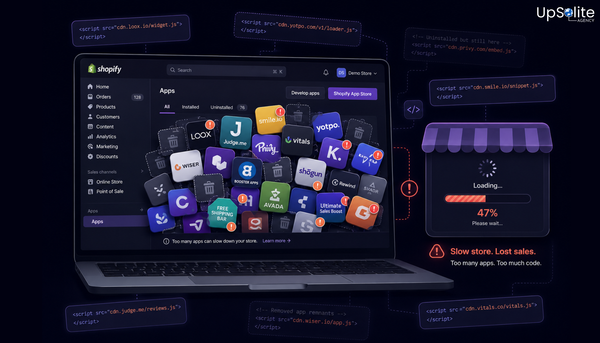

The invoice says $49 or $99 a month. That number is easy to approve — it's lower than most SaaS tools the business already pays for. The actual cost of running a page builder on your Shopify store is considerably higher, and most of it doesn't appear on any invoice.
This isn't an argument against every page builder in every context. It's an honest look at where the real cost accumulates — so stores can make a decision based on the full number, not just the subscription line.
The Subscription Is the Smallest Part
Most page builders sit in the $29–$199/month range. Over 24 months, that's $700–$4,800. That cost is visible and predictable. What it doesn't include:
- Developer time for workarounds — every feature the builder can't support natively requires injected JavaScript. Each workaround needs to be written, tested, and re-tested after builder updates.
- Maintenance cycles — when the builder updates and a workaround breaks, a developer diagnoses it, patches it, and confirms it's working. On stores with 4–6 active workarounds, this happens multiple times per year.
- QA after each builder update — any store with custom code running alongside a builder should be testing the full PDP after every update. Most don't, which means breaks go undetected until someone notices on the live site.
- Lost conversion from slow load times — a page builder PDP loading 2–3 seconds slower than it should be on mobile has a measurable impact on conversion rate. That impact doesn't show up in the builder's cost. It shows up in revenue.
Putting a Number on the Conversion Cost
The performance overhead of a page builder is real and measurable. The revenue implication of that overhead is also calculable — most stores just don't do the calculation.
| Store Revenue | Mobile Conversion Rate | 3% Improvement | Monthly Revenue Gain |
|---|---|---|---|
| $50K/month | 1.8% | 1.9% (new rate) | +$2,800/month |
| $150K/month | 2.0% | 2.1% (new rate) | +$7,500/month |
| $400K/month | 2.2% | 2.27% (new rate) | +$18,000/month |
A 1-second improvement in LCP drives approximately 2–4% better conversion on mobile. If a native rebuild delivers that improvement, the ROI calculation on the rebuild cost becomes straightforward — often measured in weeks, not years.
The speed and performance mechanics behind this are covered in: What Your Page Builder Is Really Doing to Your Shopify Page Speed.
The Developer Hour Accumulation
This is the cost that surprises merchants most when they do an honest accounting. Developer hours for page builder maintenance don't feel expensive individually — a 2-hour fix here, a 3-hour patch there. Over a year on a store with active workarounds, it adds up to a significant number.
We've done handover audits on stores where the outgoing agency had logged 40–60 developer hours in the previous 12 months maintaining injected JavaScript and patching builder breaks. At standard agency rates, that's $4,000–$8,000 — for maintenance on a product page that still had the same limitations it started with. The page was no more capable at the end of the year than the beginning.
A native Liquid rebuild, done once, eliminates that maintenance cycle. The code stays in the theme. It doesn't have a vendor update to break it.
Opportunity Cost: What Didn't Get Built
The most invisible cost of all is the features that stayed on a backlog because the builder couldn't support them. Bundle selectors. Variant-specific content. Dynamic trust elements. These aren't nice-to-haves — they're conversion levers that competing stores may already have live.
Every month a conversion-improving feature sits in a backlog because the architecture can't support it, the cost of that backlog accrues. It's not on any invoice. But it's real.
We cover the architectural reasons these features hit walls in: When a Page Builder Stops Being Enough.
The Total Cost Comparison
| Cost Category | Page Builder (24 months) | Native Liquid Build |
|---|---|---|
| Subscription | $700 – $4,800 | $0 |
| Developer maintenance | $4,000 – $8,000 | Minimal (occasional updates) |
| Conversion lost to slow load | Ongoing, not invoiced | Recovered |
| Features not built | Deferred indefinitely | Built correctly once |
| One-time rebuild cost | N/A | $3,000 – $8,000 (once) |
The rebuild cost is visible. The ongoing cost of staying on the builder is distributed across time, across invoices, and across revenue not earned. That asymmetry is why the builder always looks cheaper until someone does the full accounting.
💡 Run the Numbers for Your Store Before the Next Invoice
If you're curious what the real total looks like for your specific situation — including conversion impact at your traffic levels — we can work through it. Get in touch and we'll build an honest cost comparison together, with your actual numbers.