
Magento migrations are a different category from most platform moves. The stores are usually larger, the data is more complex, and the expectations are higher — because the business has typically been running on Magento for years and has accumulated customisations, integrations, and operational processes that all need accounting for.
We've handled Magento to Shopify migrations for stores with tens of thousands of SKUs, complex B2B pricing rules, multiple warehouses, and custom checkout logic. The migration itself is manageable. What makes it succeed or fail is how thoroughly it's planned before a single row of data moves.
Why Magento Merchants Are Moving to Shopify
Magento's power has always come with a cost — not just in licensing or hosting, but in the ongoing engineering time required to keep it running. Security patches need developer attention. Extensions conflict with each other after updates. Performance degrades over time without active infrastructure management. Hosting bills for an enterprise Magento instance are significant.
Shopify Plus changes that calculus. For most mid-market and growing enterprise brands, Shopify Plus gives them 90–95% of what they were using Magento for — without the server management, without the extension dependency hell, and without a full-time DevOps requirement. What Shopify Plus doesn't handle natively, it handles through Shopify Functions, custom apps, or the Partner ecosystem.
The merchants we talk to aren't leaving Magento because it doesn't work. They're leaving because the cost of keeping it working has become disproportionate to the benefit.
What Makes Magento Migrations Complex
Magento stores accumulate complexity over time. The things that make migration genuinely difficult aren't usually the obvious ones:
- Custom product attributes. Magento's attribute system is flexible in ways Shopify's isn't. Attributes that drive configuration, pricing rules, or filterable navigation often don't map directly and need a translation strategy.
- Tiered and customer-group pricing. Magento handles complex B2B pricing natively. Shopify Plus has B2B features, but replicating Magento's pricing structures requires careful planning — sometimes Shopify Functions, sometimes Shopify's native B2B company accounts, sometimes a combination.
- Large catalogues with relationships. Configurable products, bundled products, grouped products — Magento's product types don't map 1:1 to Shopify's variants and bundles. Each type needs a defined migration approach before data moves.
- Custom checkout logic. Magento allows deep checkout customisation. Shopify's checkout is more controlled — which is partly why it converts better — but custom checkout behaviour needs to be rebuilt using Shopify Functions or Checkout UI Extensions.
- Third-party integrations. ERP connections, PIM systems, warehouse management, and fulfilment platforms all need to be re-integrated against Shopify's APIs rather than Magento's.
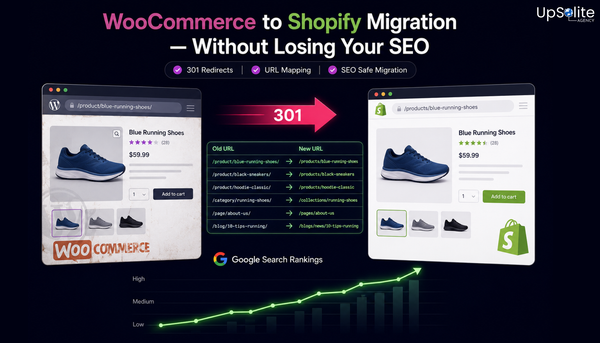
- URL structure and SEO equity. Magento URL structures rarely match Shopify's. Stores with years of SEO equity in their URLs need a thorough redirect strategy before launch, not after.
What We Handle in a Magento Migration
Data Migration
- Full product catalogue export — including configurable products, custom attributes, and all variant combinations
- Customer database migration with account reactivation strategy (Magento and Shopify encrypt passwords differently — customers need to reset)
- Order history transfer, structured for Shopify's data model
- CMS content, blog posts, and pages reformatted for Shopify
- Category hierarchy mapped to Shopify collections
SEO and Redirects
- Full crawl of all live Magento URLs before migration
- Complete redirect map from Magento URL structure to Shopify
- 301 redirects implemented for every changed URL
- Meta titles, descriptions, and structured data reviewed and carried across
- Search Console updated and monitored post-launch
Storefront Build
- Shopify Plus theme selection or custom Liquid build to match brand and UX requirements
- Product pages rebuilt with the features merchants relied on in Magento — swatches, size guides, custom tabs, related products
- Collection filtering rebuilt using Shopify's native search and filter or a compatible app
- Mobile-first build reviewed on real devices before launch
Integrations
- ERP and fulfilment platform reconnection via Shopify's Admin API
- Email platform, loyalty, reviews, and other apps set up in the Shopify ecosystem
- Analytics reinstalled and verified — GA4, ad pixels, attribution tools
- Custom Shopify Functions built where Magento's checkout logic needs replication
Magento vs Shopify Plus — The Honest Comparison
| Factor | Magento | Shopify Plus |
|---|---|---|
| Hosting | Self-managed, expensive | Cloud-hosted, included |
| Security patches | Manual, developer required | Automatic |
| Checkout customisation | Deep, unlimited | Controlled via Functions + UI Extensions |
| B2B features | Native and extensive | Growing — most needs covered natively |
| Performance | Requires active optimisation | Built-in, globally distributed |
| Developer cost | High ongoing requirement | Lower ongoing, higher at build |
| App ecosystem | Extensions (variable quality) | Reviewed app store + custom apps |
Pre-Migration Checklist
- ✅ Full Magento database backup
- ✅ Crawl and export of all live URLs
- ✅ Product attribute audit — identify what maps to Shopify and what needs a custom solution
- ✅ Pricing rules audit — document all customer group pricing and tiered rules
- ✅ Integration inventory — list every third-party system connected to Magento
- ✅ SEO baseline — record current rankings and traffic by URL
- ✅ Checkout custom logic documented — what needs to be rebuilt in Functions
How Long Does a Magento Migration Take?
A mid-size Magento store with under 5,000 SKUs and standard integrations typically takes 8–14 weeks for a complete professional migration. Larger stores with complex catalogues, custom checkout logic, and multiple integrations run 14–24 weeks. This isn't a task that benefits from being rushed — an incomplete redirect strategy or a broken integration discovered after launch costs significantly more to fix than it would have cost to get right before go-live.
🚀 Planning a Magento to Shopify Migration?
We handle the full scope — data, SEO, storefront build, integrations, and launch. Get in touch with details about your Magento store and we'll give you an honest assessment of what's involved, what Shopify Plus replaces natively, and where custom work is needed.