
Product discovery is changing. For years, shoppers found products by searching Google, clicking ads, browsing marketplaces, or visiting online stores directly. Now, AI assistants are becoming part of that journey.
Instead of searching through pages of results, customers are increasingly asking tools like ChatGPT, Google AI, and Perplexity questions such as "What's the best standing desk under $500?" or "Find me a waterproof hiking backpack for weekend trips." Rather than returning a list of links, these AI assistants can recommend products directly.
To support this shift, Shopify is investing heavily in what it calls agentic commerce. Through technologies like the Catalog API and the Universal Commerce Protocol (UCP), Shopify is making it easier for AI shopping assistants to understand product information and surface relevant products to shoppers.
This article explains what these technologies are, why they matter, and what Shopify merchants should be doing today to prepare.
How Product Discovery Is Changing
Traditional ecommerce discovery has largely depended on search engines, social media, email marketing, and paid advertising. While those channels remain important, AI-powered shopping experiences are introducing an entirely new way for customers to find products.
Instead of typing keywords into a search engine, shoppers can simply describe what they need in natural language. AI assistants analyze those requests, compare products, and recommend options that best match the customer's intent.
For merchants, this creates a new challenge. AI systems don't evaluate products the same way people browse websites. They rely on structured product data that clearly describes what a product is, who it's for, and what makes it different.
That means product information is becoming just as important as traditional SEO.
What Agentic Commerce Actually Means
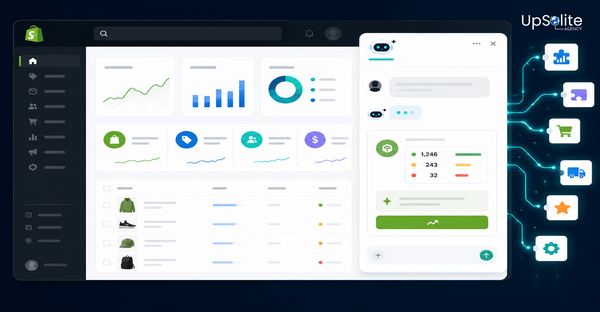
Agentic commerce is Shopify's term for AI systems acting as shopping assistants on behalf of customers.
Rather than simply displaying search results, an AI agent can understand customer preferences, compare products across stores, answer follow-up questions, recommend alternatives, and eventually guide customers through the purchasing process.
For example, instead of searching for:
- "running shoes"
a customer might ask:
- "I need lightweight running shoes for marathon training that work well in rainy weather and cost under $150."
An AI shopping agent can interpret that request, identify products that meet every requirement, explain why they fit, and present the most relevant options.
The better your product information is structured, the easier it becomes for AI agents to understand when your products are the right recommendation.
Shopify Catalog API — What It Does
The Shopify Catalog API provides AI systems with structured product information instead of forcing them to scrape data from storefront pages.
Rather than reading HTML and trying to guess product details, AI shopping assistants can access organized catalog data that includes product names, pricing, variants, availability, images, descriptions, categories, and other important attributes.
This structured approach helps AI systems better understand products and recommend them more accurately.
According to Shopify, AI shopping experiences powered through the Catalog API deliver significantly better product matching than relying on scraped storefront data, leading to higher-quality recommendations and stronger conversion performance.
For merchants, the key takeaway is simple: clean, complete product data becomes far more valuable when AI systems can consume it directly.
The Universal Commerce Protocol (UCP)
The Universal Commerce Protocol (UCP) is Shopify's infrastructure for connecting merchants with emerging AI shopping experiences and future commerce channels.
Instead of every AI Protocol building its own custom integration with every ecommerce store, UCP provides a standardized way for product catalogs, inventory, pricing, and commerce data to be shared across supported shopping experiences.
This allows AI assistants and other commerce platforms to access consistent, reliable product information while merchants continue managing everything inside Shopify.
As more AI-powered shopping experiences appear over the next few years, Shopify's goal is to make participating in those channels much simpler through a common infrastructure rather than requiring merchants to build separate integrations for each platform.
What This Means for Your Store
AI shopping assistants can only recommend products they understand.
If your catalog contains incomplete, inconsistent, or vague product information, your products become much harder for AI systems to interpret accurately.
Compare these examples.
Weak product title:
- Blue Shirt
Better product title:
- Men's Lightweight Long Sleeve Linen Shirt – Sky Blue
The second title immediately provides meaningful information about the customer, material, style, color, and intended use.
Another example is product variants.
Weak product data:
- Missing size information
- No material details
- Incomplete color options
- No product dimensions
Strong product data:
- Complete size variants
- Accurate colors
- Materials listed clearly
- Dimensions and weight included
- Detailed specifications
- Rich product descriptions
The more complete your catalog becomes, the easier it is for AI systems to confidently recommend your products for highly specific customer requests.
What You Can Do Right Now
Although AI shopping channels are still developing, merchants don't need to wait before preparing their stores.
- Review product titles and make them descriptive rather than generic.
- Write detailed product descriptions that explain features, materials, intended use cases, and key benefits.
- Complete every product variant, including sizes, colors, dimensions, and other specifications.
- Fill in relevant metafields to provide richer structured product information.
- Use Shopify's official product taxonomy wherever possible to help products be categorized consistently.
- Keep pricing, availability, and inventory information accurate and up to date.
- Audit your catalog regularly for missing attributes and inconsistent product data.
These improvements benefit not only future AI discovery but also your storefront, search engine optimization, customer experience, and conversion rates today.
Looking Ahead
Agentic commerce is still in its early stages, and no one can say exactly how AI shopping will evolve over the next few years.
However, the direction is becoming increasingly clear. AI assistants are moving beyond answering questions—they're becoming active participants in product discovery and purchasing decisions.
Merchants who invest in clean, structured product data now will be better positioned as these new shopping channels continue to mature.
Preparing your catalog today means you're ready to take advantage of tomorrow's AI-powered commerce experiences as they become more widely adopted.
Need Help Preparing Your Store for AI Commerce?
If your product catalog has grown over the years, cleaning up titles, variants, metafields, taxonomy, and structured product data can feel like a significant project.
We help Shopify merchants audit their product catalogs, improve structured product data, and prepare stores for emerging AI-powered shopping channels while also improving SEO and customer experience.
Get in touch if you'd like help making your Shopify store ready for the next generation of AI commerce.